
Medical Case Management
Finally thriving
Medical Case Management Program helps teacher’s son get the care he needs to live
Most of us know what it’s like to not feel hungry. Usually it’s soon after you eat a big meal; sometimes when you’re sick. After a while, you’re hungry again, so you eat.
Now imagine never being hungry. Ever. You’re unable to take in the calories you need to fuel your body. If you do try to eat, you vomit it right back up.
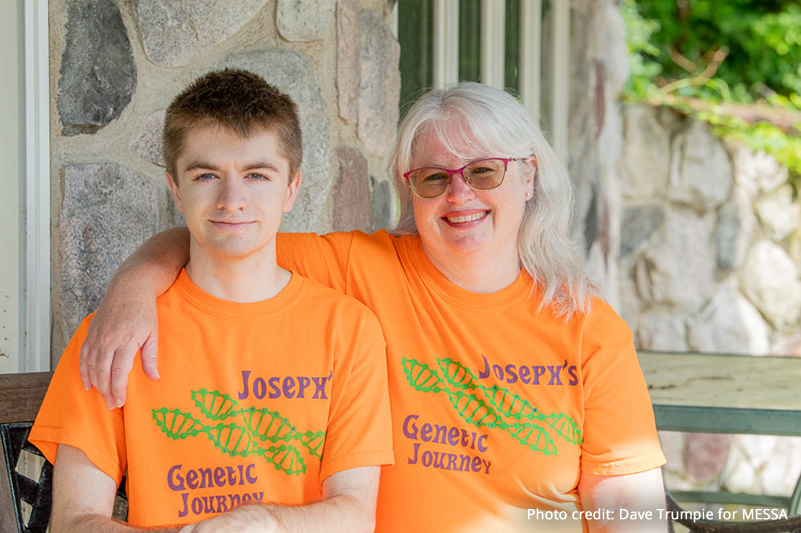
Heidi Tyner, a middle school teacher in Delton-Kellogg Schools, first became concerned about her son Joseph when he was 9 months old and wasn’t meeting his growth projections.
Following a “failure to thrive” diagnosis, Joseph still wasn’t improving by age 3, so surgeons installed a surgical gastrostomy tube, commonly called a “G-tube,” leading to Joseph’s stomach. The Tyners saw multiple specialists. They went to an inpatient intensive feeding program. Still, they had no real answers as to why Joseph couldn’t eat.
When he was 6, doctors recommended weaning Joseph off the G-tube and just feeding him orally.
“But Joseph never had an appetite,” Tyner says. “We fought and struggled to get him to eat, adding calories to food whenever possible through (the food additive) Duocal, extra butter, heavy cream, etc. He never hit his milestones for growth or weight, he was sick all the time, he vomited when he ate, and we were at our wits’ end trying to figure out why.
“He was going to the doctor constantly, having more tests, more referrals and more questions that went unanswered,” she recalls.
“In the meantime, he was skeletal and his skin was gray. My son was dying and we still had no answers.”
Tyner was on the phone with a MESSA member service specialist one day, when the service specialist suggested Tyner enroll Joseph in MESSA’s Medical Case Management Program, which provides a registered nurse who can help coordinate care, give advice and deal with the medical bureaucracy.
“I didn’t even know having a caseworker from an insurer was an option, so I had never asked for one,” Tyner says. “The fact that the MESSA member service specialist saw what was happening and suggested the Medical Case Management Program changed everything for us.”
Joseph’s case manager got him into Mayo Clinic and set up appointments with specialists there.
“Getting into Mayo was a dream come true,” Tyner says, “because it gave us hope. That would never have been possible if not for MESSA.”
The Tyners spent two weeks at Mayo, getting full work-ups from multiple specialists. The gastrointestinal specialist there determined that the next step was installing a “GJ-tube,” which fed directly into Joseph’s small intestine, bypassing his stomach completely. It worked.
“As a result, he is alive today,” Tyner says.
Joseph, now 20, will likely need a feeding tube for the rest of his life, but he’s able to get the nutrition he needs to “live a relatively normal life,” Tyner says.
In fact, the family recently went to the Great Wolf Lodge to celebrate Joseph’s younger brother’s high school graduation. Joseph was able to spend three hours (the amount of time each day he’s allowed off the feeding tube) in the indoor water park. After drying off, he reconnected to his tube, and the family played MagiQuest, miniature golf and bowling.
Throughout Joseph’s medical journey, Tyner has kept a close eye on the explanation of benefits statements as they’ve come in. Between Joseph’s tests, treatments, surgeries, specialist visits, home health nurses, feeding tube supplies and more, “the medical costs that we have accrued over his 20 years of life have been staggering,” she says.
“Thankfully, MESSA covered everything that the doctors and therapists recommended,” Tyner says. “It is because of MESSA that we were able to always search for answers — as impossible as they were to find.”
Just as valuable, MESSA provided “peace of mind,” Tyner says. “Whatever we needed to do for Joseph, we could figure it out because MESSA was behind us and would help us along the way. I depend on that each and every day.”
Tyner has words of advice for younger colleagues who may not yet understand the importance of having excellent medical coverage: “We all know that we would do anything for our children and their health and safety. Having the best insurance is never the wrong decision.
“You never know what life is going to throw at you or your family.”