The fight to walk again
School social worker beats paralysis with MESSA’s help, own stubbornness
When Ellen Mazique-Sydloski stepped out of the University of Michigan Hospital in June 2021, she hoped the spinal surgery to correct her scoliosis would relieve the pain she had long experienced walking in the neighborhood or tending her garden.
Instead, Mazique-Sydloski, who also has brittle bone disease, found herself on a strenuous six-month journey of delirium, excruciating pain, and wondering whether she’d ever walk again. For a while, befuddled doctors didn’t know why she couldn’t walk weeks after the surgery.
During a second surgery in August 2021, doctors discovered Mazique-Sydloski, 54, had suffered a spinal cord injury sometime after the first surgery that left her paralyzed from her waist down. When she was told she might not be able to walk again, Mazique-Sydloski didn’t accept that news and knew she was in for the fight of her life.
Amid the rigorous challenge and frustrated from toggling in and out of ill-equipped nursing homes and rehab centers, Mazique-Sydloski made perhaps the most important phone call of her life to MESSA’s Medical Case Management program (MCM). She had used the program before for past health conditions.
“To have MESSA fight for the specialized treatment, I would never be here,” said Mazique-Sydloski, a social worker at Barry Intermediate School District. “If I was still in that rehab home, I wouldn’t be where I am right now. I wouldn’t be working again. I wouldn’t be walking. I’m totally convinced of that. There’s just no way. I needed that specialized care.”
The MCM program provides MESSA members and covered dependents who have serious illnesses or injuries with advocacy and personal support from a registered nurse. The eight staff nurses work directly with 175 to 200 members annually to ensure they access the right care and achieve their highest quality of life.

MCM Mary Kay Erickson
“We want to come alongside and advocate and support and help coordinate care,” said Mary Kay Erickson, nurse coordinator for MCM. “We help them navigate this health care system, and help them to know what they don’t know.”
When Mazique-Sydloski had her initial surgery in June 2021, it was deemed successful. After she left the hospital, she spent a couple of weeks at a rehab facility in Pinckney, walking and building her strength. Finally discharged, she went home, but her condition gradually worsened within a few weeks.
“I had therapy at home but began to have issues with pain, and I was not able to urinate,” Mazique-Sydloski said. “I went to the ER in my area twice and they just sent me home. I went to my primary care physician and to a pain doctor, as well. No one caught the problem. I was just prescribed more oral morphine for pain.”
On Aug. 13, 2021, the pain so dire, a family member called 9-1-1. Mazique-Sydloski was later rushed to U-M Hospital for an emergency surgery.
During the surgery, doctors discovered a fracture and an abscess at the base of her neck. They had to clear the infectious fluid from her spinal cord and place plates in her spine.
“I lost the ability to move from just under my breastbone down,” she said. “I had no feeling, no movement. I had delirium and was placed on suicide watch. They were worried (the infection) may have gone to my brain. When I came to, I had to learn to live life as a paraplegic.”
By her own admittance, Mazique-Sydloski’s stubbornness came in handy during her fight. Wearing a brace, she spent weeks in various rehab centers with limited resources, making no progress.
Until she called MCM.
“My first thought was we’ve got to get her out of there,” Erickson said. “She was just laying around, and they didn’t know what to do with her. Her physical function was in a further decline.”
Erickson connected with Julie Hartmann, a nurse case manager contractor, to help with Mazique-Sydloski’s treatment. The three collaborated and found Special Tree Rehabilitation, a Romulus-based facility that has an inpatient neurological unit.
Erickson and Hartmann helped Mazique-Sydloski get a written referral from her providers. Meanwhile, Mazique-Sydloski met Special Tree’s patient criteria and MESSA’s MCM program approved the request.
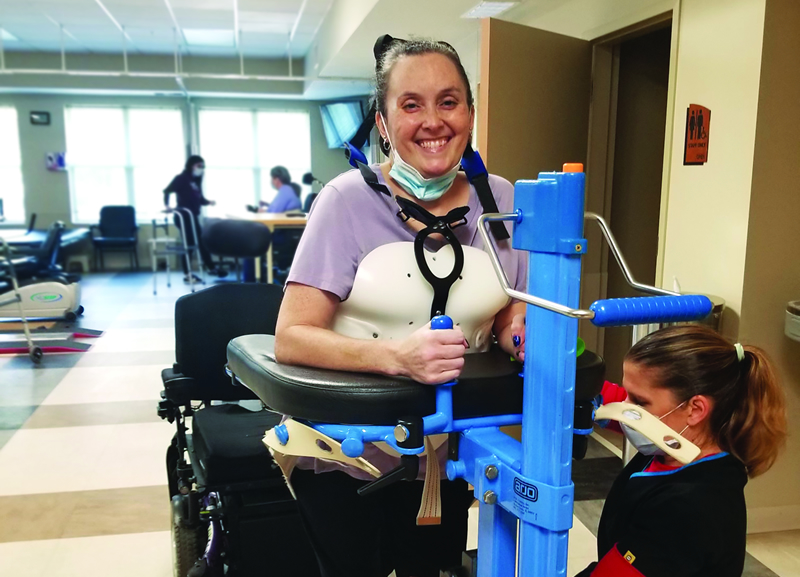
Three months after specialized care and demanding exercises, including pool and anti-gravity therapy, Mazique-Sydloski was able to walk out of Special Tree and into her home outfitted by MCM with a ramp, grab bars, a tub bench and other accommodations.
“All of my doctors thought I would never walk again,” said Mazique-Sydloski, who gets around with the help of her cane and walker. “I have definitely beat the odds. I nearly died in August (2021). I am able to live and enjoy my family.”